
The Light in the Piazza, now playing at The Huntington and directed by Loretta Greco, is a romantic and richly emotional musical set in 1950s Florence. With a book by Craig Lucas and music and lyrics by Adam Guettel, the story follows Margaret Johnson and her daughter Clara as they vacation in Italy. When Clara meets and falls in love with an Italian named Fabrizio, Margaret has to confront the secrets from her daughter’s past and her own fears about the future. What unfolds is a story about love, maternal protection, vulnerability, and letting go.
The Mother-Daughter Heart of It All
Emily Skinner as Margaret Johnson. Perfection. What a wonder, a beauty, a joy to see on stage. She brings edge, humor, rawness, warmth, and vocal brilliance to this complex character. Every moment she’s on stage is magnetic. Her performance is grounded and real and deeply felt. It’s clear she’s the emotional anchor of this production, and she wears that responsibility with incredible grace.
Sarah-Anne Martinez as Clara Johnson is equally excellent. She captures the wide-eyed wonder and sweet vulnerability of Clara, but never plays her as a one-note character. Clara feels whole, real, and entirely her own person. Vocally, this role is so beyond difficult, and Martinez sings it as though she was born to. A stunning performance from start to finish.
Meet the Naccarellis
Joshua Grosso as Fabrizio Naccarelli is the standout among standouts. Even when singing entirely in Italian, he tells a complete emotional story with every facial expression, gesture, and choice. He fully embodies Fabrizio, and his chemistry with Sarah-Anne Martinez is pure magic. Their duet “Say It Somehow” to close Act I is worth the ticket alone. Just wow. Any time that I see his name on a cast list, I’ll be purchasing a ticket.
William Michals and Rebecca Pitcher as Signor and Signora Naccarelli are a charming duo. William plays the proud patriarch with ease and presence, while Rebecca Pitcher’s cheeky aside to the audience during “Aiutami” was a comic highlight of the night.
Alexander Ross and Rebekah Rae Robles as Giuseppe and Franca round out the family with heart, wit, and heat. Alexander’s physical comedy and strong timing were pitch-perfect, especially in the scenes where language barriers create chaos. Rebekah brought passion and fire to Franca, clearly showing she’s a woman with depth and vision beyond her time. The fact that she speaks English added another layer to the family dynamic, and Robles used that well to bridge the gap between families.
Dressed for the Piazza
Costume designer Alex Jaeger absolutely nailed the era and aesthetic. The dresses, the suits, the silhouettes—everything transported the audience right into mid-century Italy. Every outfit felt intentional and perfectly matched the character. Special praise to Clara’s flowing looks, Franca’s fierce fashion, and Margaret’s tailored elegance.
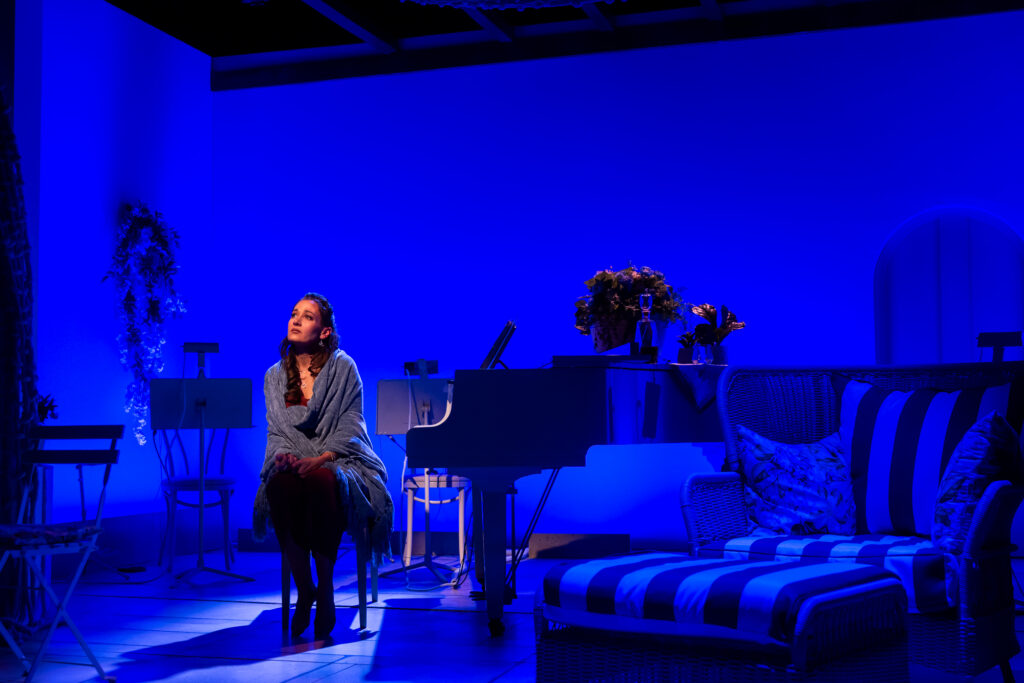
The lighting design by Christopher Akerlind and projections by Yuki Izumihara also helped paint the world. One clever moment I loved: the projected street lamps shifting across side panels as characters strolled the streets. It was a small detail, but it made a big impact.
A Feast for the Ears
Under the musical direction of Andrea Grody, this incredibly complex score soars. It’s a technically demanding musical, and the orchestra handled it beautifully. The curtain call applause for the musicians was well-earned. The cast navigated Guettel’s challenging music with such ease that you almost forget how intricate it all is. The vocals across the board were excellent and matched the emotional weight of each scene and song.
Not Quite La Dolce Vita
While Andrew Boyce’s scenic design was lovely overall, there were moments when the set changes started to feel like too much. Pieces kept rising, moving, entering, exiting—it became something I noticed, and not always in a good way. Each piece on its own was beautiful, but not all felt essential to the story being told.
The ensemble felt underutilized. Because the story focuses so heavily on just the two families, the ensemble often seemed to be there to shift furniture. While they executed those transitions cleanly, I found myself wishing they had more chances to shine in their own right.
And lastly, while I admire how committed the show is to keeping parts of the dialogue and music in Italian, I did find myself longing for subtitles or translations during some of the songs. The actors did wonderfully conveying tone and emotion, allowing the audience to know the gist, but I still wish I had a clearer idea of what some lyrics meant. Not only for clarity, but also for accessibility.
Final Thoughts
This production of The Light in the Piazza is simply put: gorgeous. It’s filled with incredible performances, beautifully orchestrated music, and emotional storytelling. It doesn’t have the high-energy pacing of more familiar musicals, but that’s part of what makes it so special. It asks you to slow down and consider what it really means to love someone exactly as they are.
Whether it’s 1953 in Florence or 2025 in Boston, that message is as relevant as ever.
The Light in the Piazza runs at The Huntington through June 15.
 Booked & Scene
Leave a comment