
Penelope at the Lyric Stage Company of Boston directed by Courtney O’Connor with music direction by Dan Rodriguez, turns its gaze away from the hero’s journey and toward the woman who stays behind. With music, lyrics, and arrangements by Alex Bechtel and a book by Bechtel, Grace McLean, and Eva Steinmetz, this one-person musical drops us into the decades Penelope spends waiting for Odysseus to return, using a contemporary score to explore the question of what it costs to put your life on hold for someone else’s story.
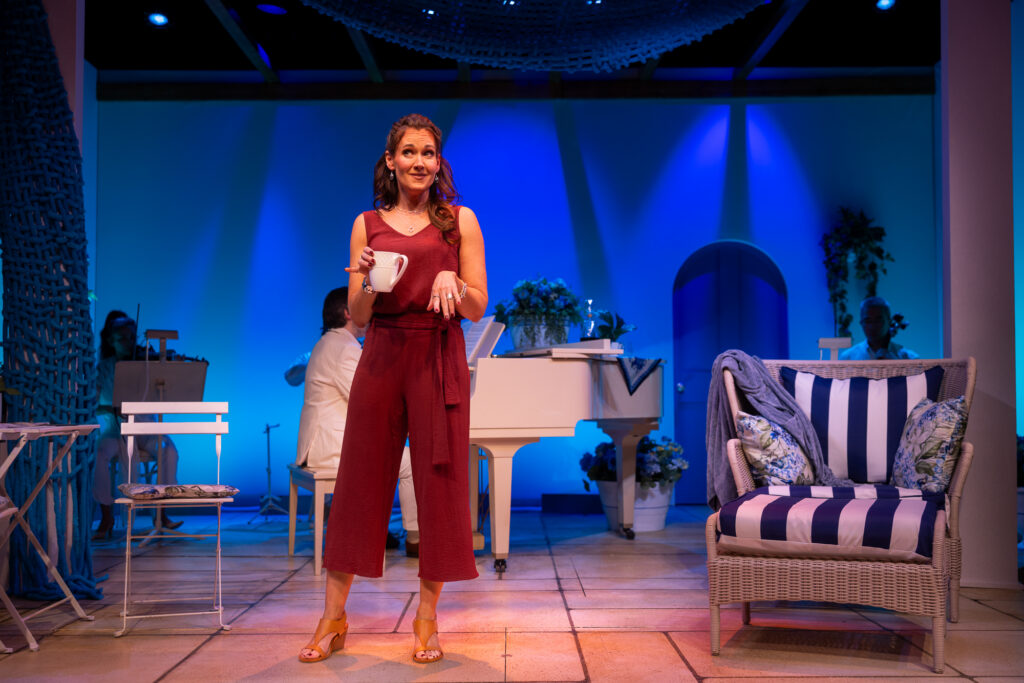
Waiting for Her Cue: Aimee Doherty as Penelope
Let me start here. One-person shows are a marathon, not a sprint, and anyone who takes one on deserves real applause. Holding an audience for 80 minutes, singing almost the entire time, building the world, tracking the emotional arc, and doing it seven times a week is no small thing. Aimee Doherty had several genuinely delightful moments, especially her playful audience work in “Drunk Iliad,” where her comic instincts loosened the room and gave us a glimpse of the production’s most engaging version of itself. Her exchanges with Athena also showed strong timing and a clear knack for landing a punchline.
That said, this wasn’t a performance that fully came together for me. There were multiple songs, including the opening number, where the pitch issues stretched on long enough that it pulled focus from the story. In a piece where the music is doing so much of the emotional heavy lifting, that made it hard to settle in and be able to be drawn deeper into Penelope’s world. It’s especially tough because Doherty is a performer who has absolutely dazzled in other Boston productions. Knowing what she’s capable of made me wish we’d gotten a night where every note was hit and the we got to see her shine.
The Real Greek Chorus
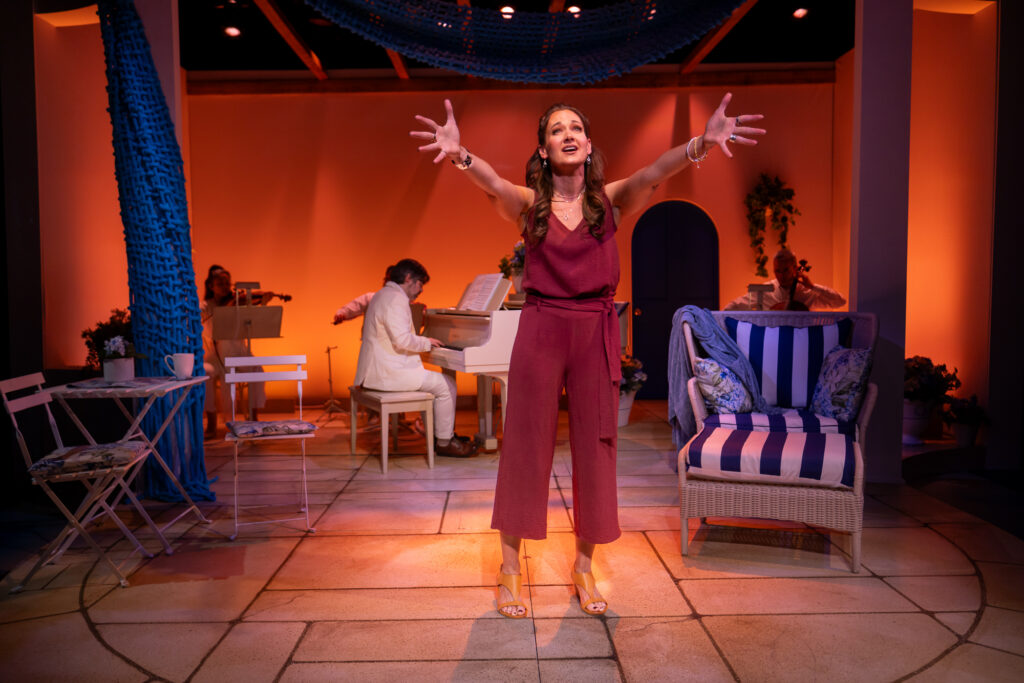
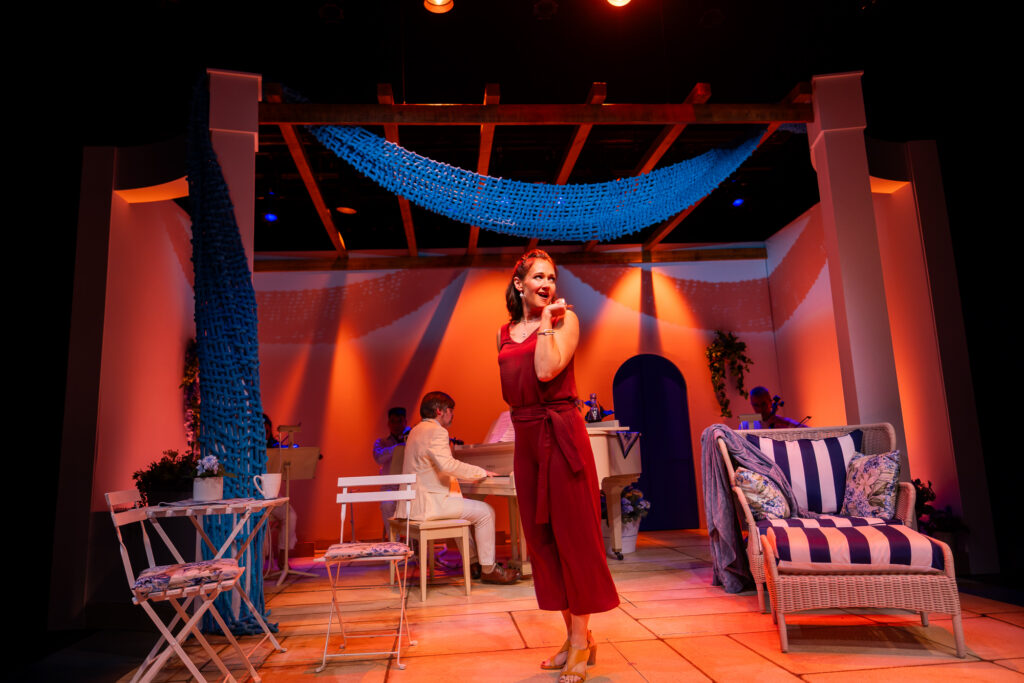
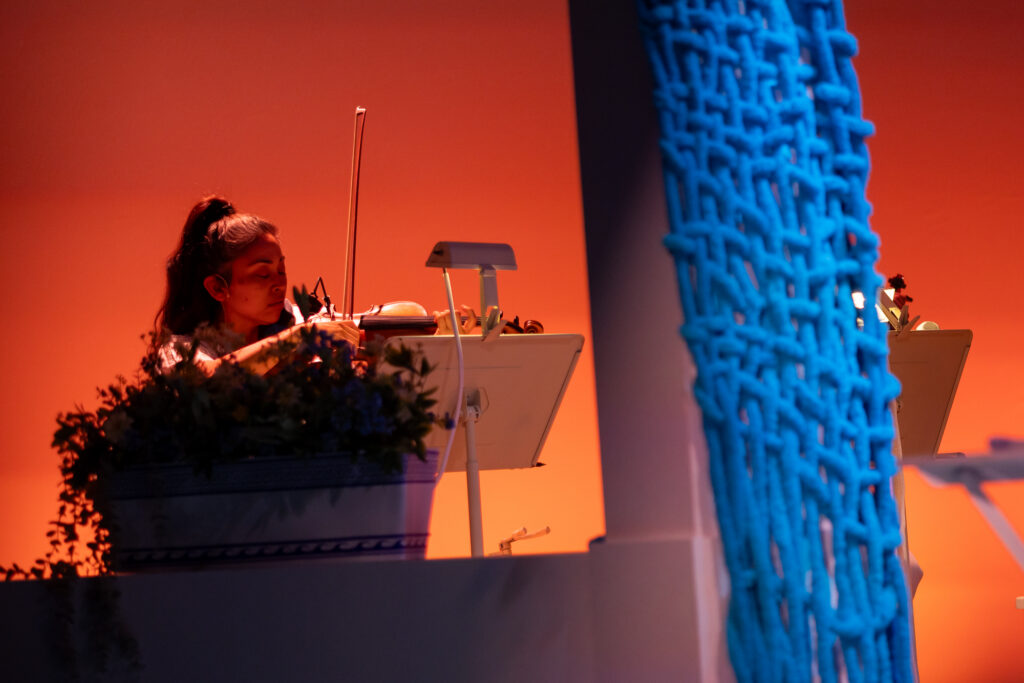
The true stars of the evening were the musicians under the direction of Dan Rodriguez. Marissa Licata on violin, Ethan Wood on viola, Josh Goldman on percussion, and Kett Lee on violincello didn’t just accompany the show, they were the pulse of it. Under Rodriguez’s direction they created a sound that was rich and emotionally grounded from the first note to the last.
Their onstage presence added much-needed energy, creating some of the show’s most memorable moments. The banter with Penelope, the moments where they became the voice of Athena, the way they shaped the arc of each song. It all worked. Every time the focus shifted toward them, the storytelling sharpened and the world of the piece felt fuller.
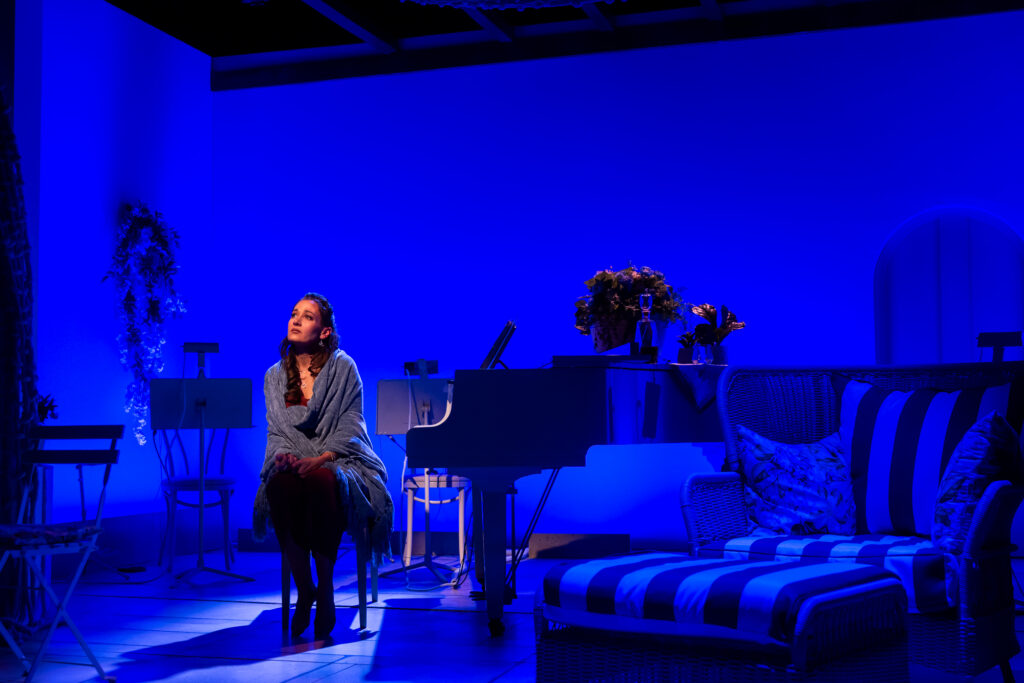
A separate and very deserved shout-out to Karen Perlow for lighting that quite literally moved like water. The shifting reflections and ripples brought a sense of the sea — and of time passing — into the room in a way that the physical staging often did not.
The Longest Night in Ithaca
Yes, waiting is the point. I get the concept. But there’s a difference between making us understand waiting and making us experience it in real time.
There were extended stretches of stillness that went on far longer than they needed to. Looking into the distance. Sitting in silence. Miming the loom.
Pause after pause after pause.
After pause.
A few of those moments would have been powerful. As many as we got started to drain the momentum and made the 80 minutes feel much longer. Instead of sharpening the theme, it started to feel like the audience was being asked to endure the waiting with Penelope.
The choice to forgo physical props also didn’t quite land for me. The loom is such a central image in Penelope’s story, and having to imagine it instead of seeing it removed a tactile anchor that could have grounded the piece. The dance at the end, when Odysseus finally returned, felt stylistically out of sync with what we had been watching and didn’t give the emotional release it seemed to be aiming for.
And as someone who always asks what a show is sending me home with, I found myself searching for a clearer takeaway. Beyond the idea that if you wait long enough someone might return, the central thesis felt hazy — and not in a way that opened up new questions so much as one that left the emotional journey unresolved.

Unraveling the Thread
If The Odyssey is your Roman Empire and you’ve always wanted more of Penelope’s perspective, there is absolutely an audience for this piece. And if you already have tickets, pay close attention to the lighting and let yourself get swept up in the band because they are doing truly gorgeous work.
For me, this wasn’t the strongest offering I’ve seen at the Lyric. As a audience member and a critic, I’m always chasing that feeling of walking out of a production with a clear message, I found myself continually circling back to the idea that a life spent waiting might eventually be rewarded. That’s a tough sell for me but if you’re drawn to intimate, one woman musicals, and you’re curious about what happens when the person left behind finally gets the mic, you may find more in the stillness than I did. If you’re on the fence in this final week and the source material isn’t a personal favorite, I’d be inclined to wait and see what’s next.
But as a meditation on endurance, on the stories we inherit, and on the question of whether waiting is devotion or self-erasure, Penelope certainly gives you something to sit with — even if, for this reviewer, it didn’t fully weave together.
Penelope runs at Lyric Stage through March 1, 2026.
📸: Nile Scott Studios

 Booked & Scene
Leave a comment